What to Expect in a Shockwave Therapy Session
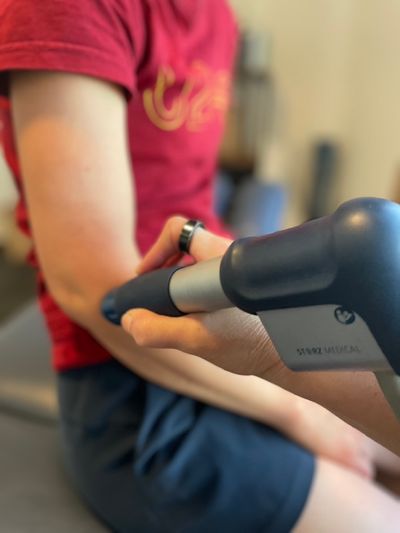
Shockwave Therapy is a new buzzword in the injury and treatment world. You’ve heard teammates and maybe even your neighbour talk about this ‘new’ treatment.
Two questions come up: what exactly is Shockwave Therapy and more importantly what should you expect in the first Shockwave Therapy session?
I am going to cover more of the what to expect on the first session and the treatment cycle.
Assessment to see if you are candidate for Shockwave Therapy? We will start with a quick assessment to see what is going on in your body and whether we believe shockwave is going to stimulate results. If we don’t feel there will be a high level of success, we will tell you and point you in the most appropriate direction.
What should do I wear during treatment? We need access to the skin to apply gel. So clothing will depend on the body part treated. If we are treating your foot you’ll wear shorts or pants that can rool up and no socks. With shoulder/upper back we may ask you to wear a jog bra, roll up a t-shirt or depending on the location, remove the t-shirt. Hips you are likely hiking shorts up or down to give access to the treatment site. We always will work with what ever you are most comfortable with.
How long does treatment take? First session is the assessment and treatment combined and will be approximately 35 mins. Follow up treatments are approx 15 minutes. Every session will also include Active Release Technique. You’ll quickly understand the timelines and how much we can accomplish in a session..
Does it hurt during the treatment? Treatment can be quite uncomfortable over the injured site and you will usually feel it diminish during the session. We aim to make it as toleratable as possible.
Does it hurt after the session? Typically there is no residual pain after the session from the treatment.
How long will it take to fix my injury? Depends on the injury but typically we are shooting for 3-5 sessions one week apart. Most patients feel a significant change after the first session
What is the cost of treatment? At the time of writing this, the fee is $145 for the initial session and $130 for follow up sessions.
Do I have to pay for all of my sessions upfront? No. You will pay as you receive the sessions. We don’t believe in bulk upfront payment because we don’t know for certain how many sessions we’ll need. We are guided by how your body responds
Will my insurance cover treatment? Yes in most cases. I am a Registered Massage Therapist so the treatment will be covered under your Registered Massage Therapy insurance allotment.
There is a reason you have been hearing more and more about Shockwave Therapy. The results are phenomenal. Are you struggling with plantar fasciitis, achilles tendonitis or tennis elbow? Are you looking to regenerate tissues and accelerate the healing process on a hamstring tear? Or are you looking to decrease tension in your upper shoulders from your days as a computer Jockey.
If it’s soft tissue and it’s a problem, there is a great chance Shockwave Therapy can help you.
I have been treating injuries with Shockwave Therapy in Ottawa since 2010 making me one of the most experienced Shockwave Therapy practitioners in Ottawa.
I want to highlight that I use a Storz Shockwave Machine. All machines are NOT created equal. The Storz is the machine that the majority of the research has utilized.
Schedule Now! Ask Us A Question

ACTIVE RELEASE TECHNIQUE
ART is a precise, hands-on approach to treating muscle, tendon and soft-tissue problems. With over 25 years of experience using ART, I look beyond the painful spot to identify and treat restrictions that may be affecting how you move.
SHOCKWAVE THERAPY
Shockwave Therapy is an effective option for stubborn tendon and soft-tissue injuries. I combine Shockwave with over 25 years of clinical experience and Active Release Techniques (ART) to look beyond the painful spot and address what may be contributing to the problem.
GROUNDED STRENGTH
A focused treatment session designed to restore natural foot function through mobility, stability, and strength work. Working together to improve joint movement, build intrinsic foot strength, and enhance balance—helping you move with better control, resilience, and connection to the ground.